
Orange County Parole and Probation
Parole and probation can both place a released person under rules in the community, but they begin in different ways. The Virginia Parole Board decides parole in eligible state cases. The Virginia Department of Corrections, or VADOC, supervises parolees and people assigned to state probation through Community Corrections. An Orange County judge may instead order probation, suspend part of a sentence, or direct a person into local pretrial services. That court-based route does not prove the person ever served a VADOC prison term.
Start with the legal order, not a label heard from another source. The Orange court file can show the sentence, suspended time, probation term, and later violation proceedings. A CVRJ release event shows a physical custody change. The VADOC locator may show state custody or supervision. Each record covers only its own part of the timeline, so one result should not be stretched into proof of the whole case.
| Feature | Parole | Probation |
|---|---|---|
| How it begins | Release from a parole-eligible prison sentence after a Board decision | An Orange County court imposes or suspends a sentence with supervision terms |
| Decision source | Virginia Parole Board | Sentencing court |
| State supervision | VADOC Community Corrections | VADOC when assigned to state probation |
| Local layer | Not a substitute for a parole decision | OAR/JACC may handle documented local probation or pretrial work |
| Proof it ended | Discharge or other official completion record | Court or supervising-agency completion record |
- Parole
- Conditional community release from a parole-eligible prison sentence before full sentence discharge.
- Probation
- Court-ordered supervision that may follow confinement or replace an active jail term.
- Post-release supervision
- A supervised period that begins after physical confinement ends.
- Discharge
- Official completion of the custody or supervision obligation covered by that record.
Verify Orange County Post-Release Supervision
The core question is whether a named person is currently assigned to parole, probation, local pretrial services, or no supervision at all. Use the name, birth information when displayed, case number, and VADOC number to avoid a same-name error. Supervision may follow the person’s residence and assigned district rather than Orange County, so a sentence entered in Orange does not guarantee that District 26 remains the supervising office.
- Find the Orange court case through the Virginia court case systems. Check the sentence, suspended term, probation language, and later violation entries.
- Use the VADOC Inmate and Supervisee Locator with the full name or VADOC number. Read status and location wording carefully.
- Open the official Community Corrections path and identify the district tied to the assigned supervision address.
- Contact that district and ask what current status may lawfully be confirmed. Do not treat a missing public result as proof that supervision ended.
- For local pretrial or local-probation placement, compare the court order with OAR/Jefferson Area Community Corrections records rather than calling the placement parole.
- When final completion matters, request the discharge or completion record from the agency or court that issued it.
The Orange County released-inmate search and record path can help establish the custody event before the supervision record is checked. That sequence is useful when a person left CVRJ but may have transferred to VADOC or another authority.
Orange County's Two Supervision Layers
Orange County has a state layer and a local layer. VADOC Culpeper Probation and Parole District 26 handles state probation, parole, and related Community Corrections assignments for Orange, Culpeper, Greene, and Madison. The DCJS program directory documents OAR/Jefferson Area Community Corrections and its Orange office for local pretrial and local-probation programs tied to Orange courts. The two offices are not interchangeable.
A person may leave CVRJ for supervised pretrial release before conviction. In that sequence, the court sets terms, OAR manages the local program, and CVRJ or VINE confirms the physical change from custody. Another person may finish a state-prison term and begin VADOC parole or post-release supervision through District 26. The sentencing or release order identifies which path controls. A broad phrase such as “on probation” is too vague to select an office or prove the end of a particular booking.
VADOC District 26
Culpeper Probation & Parole
1845 Orange Road
Culpeper, VA 22701
540-829-7369
OAR/JACC Orange Office
Local pretrial and probation programs
101 North Madison Road
Orange, VA
540-672-2881
Confirm office assignments before relying on them. VADOC identifies the District 26 chief and service area in its current directory, but assignments can move when a person’s approved residence changes. OAR matters also appear on the Orange General District Court schedule, which links the local program to the court process rather than to the Parole Board.
Note: A Culpeper Re-Entry Council meeting is listed for the first Wednesday monthly, but the schedule should be confirmed before attendance.
Orange County Parole Decision Records
A parole decision and an actual release are separate events. The Virginia Parole Board publishes monthly decision reports for cases it considered. Reports can include the VADOC number, name, case type, decision and certification dates, jurisdiction, offense and judgment details, estimated time served, reasons or conditions, and member votes. The verified decision words are “Grant” and “Not Grant.” Match the VADOC number and month because a name alone is weak proof.
The Board’s monthly parole-report archive provides the official route to those records. A Grant still does not state the time a person walked out. Release planning, placement, detainers, and supervision setup can follow. Confirm the later custody event in VADOC records, then confirm the supervision assignment with District 26 or the district serving the approved residence.
The archive view below shows where monthly decision material is organized. It is a decision source, not an Orange County release roster.
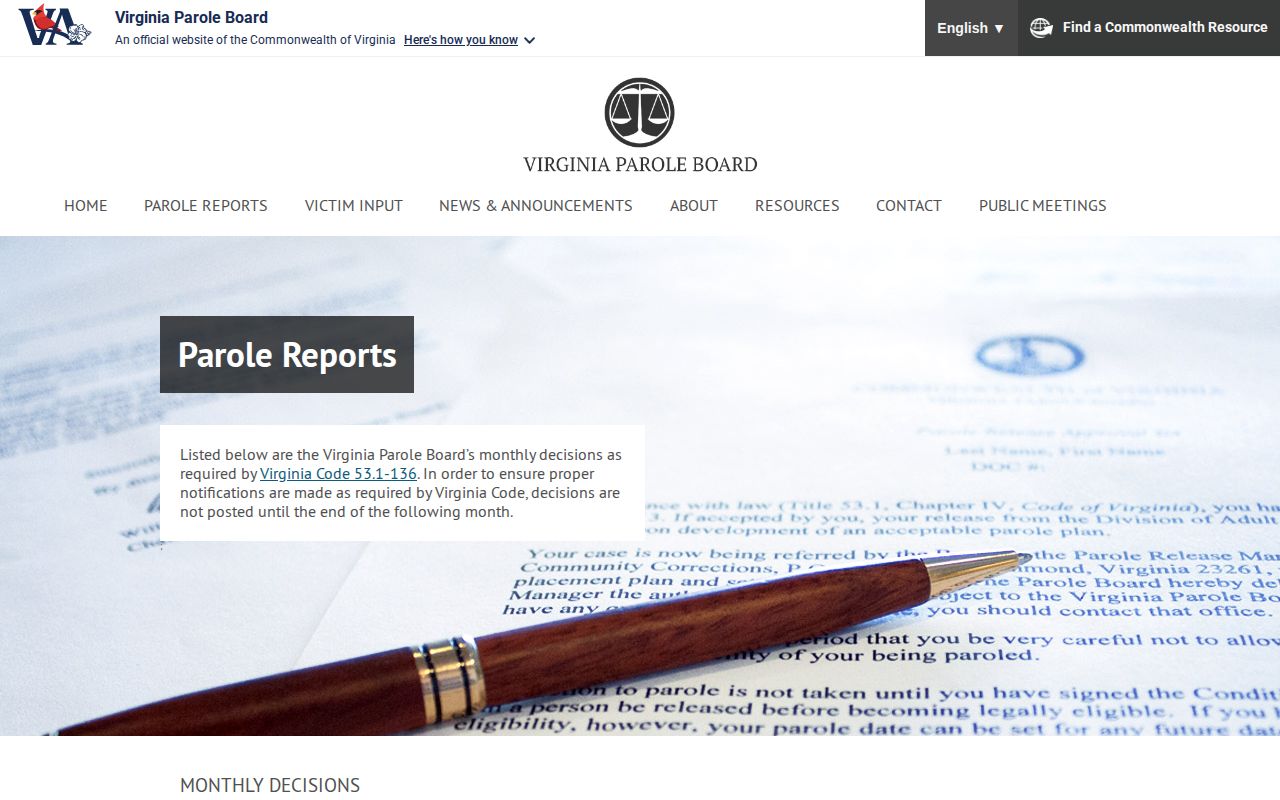
The report month and VADOC number provide the best match, while the later locator or discharge record establishes what happened after the vote.
Orange County Parole Hearing Records
The Board’s calendar is event-driven. It lists upcoming public meeting information, agendas, live-meeting access when offered, and past minutes. It should not be read as a monthly list for every Orange County prisoner. Current law has required public final deliberation and voting in applicable matters since July 1, 2024, yet the meeting schedule remains distinct from an individual custody or release record.
Parole eligibility also needs care. Virginia’s general rule bars parole for many felony offenses committed on or after January 1, 1995, but statutory exceptions exist. Section 53.1-151 contains first-eligibility formulas for eligible sentences, while § 53.1-154 governs review timing. Statutory versions change. The research was checked on August 8, 2026, and eligibility should be confirmed under the version that governs the sentence rather than inferred from the offense date alone.
The Virginia Parole Board public-meetings page is the official calendar source.

The calendar confirms Board proceedings. It does not replace the monthly decision report, VADOC status record, or later proof of physical release.
Orange County Absconder and Warrant Checks
Supervision conditions come from the court order, parole decision, release plan, and instructions of the assigned office. They can govern reporting and other conduct, but the terms differ by case. Read the signed record instead of assuming that one person has the same rules as another. An alleged violation can lead to a hearing, a new court order, a warrant process, or return to custody. It does not by itself show the final result.
An absconder is a person alleged to have stopped reporting or following supervision rules. The term does not erase the conviction, prove a new conviction, or establish that a warrant remains active. VADOC’s Most Wanted page is selective, not a full Orange County list. A missing name has no value as warrant clearance.
Check the sentencing court for a capias, violation proceeding, or later order. A capias is a court command to take a person into custody. Contact the assigned probation or parole district for the supervision path, and use the proper law-enforcement office for current warrant confirmation. Sections 53.1-149 and 53.1-161 through 53.1-163 address arrest and warrant processes for parole or probation cases. Do not approach someone based on a public result.
VINE can send local-jail custody-event alerts, but it is not a supervision violation system. A release or transfer notice can mean entry into VADOC custody. State victim notifications use the separate NAAVI system, and registry alerts apply only to people who must register. None of these tools replaces a court order or confirmation from the supervising office.
Note: Check the case number and assigned office before drawing conclusions from a name appearing, or not appearing, in a public list.
Ending Orange County Post-Release Supervision
Physical release, the first day of supervision, and final discharge may fall on different dates. An Orange court can suspend confinement and impose probation. VADOC can release an eligible prisoner to parole. A person can complete incarceration yet remain subject to a term of post-release supervision. For that reason, “released” should not be restated as “finished the sentence.”
The VADOC public locator covers people in custody or under supervision, so a person who completed all VADOC obligations may no longer appear. Absence is only a lead. Ask VADOC or the supervising district for the releasable discharge record, or request the controlling completion order from the Orange court. When a projected or actual custody date is also at issue, the Orange County release date lookup separates sentence computation from supervision status.
Keep a simple evidence chain: court sentence, custody or release record, assignment record, and discharge or completion order. This preserves the difference between a local jail exit, state-prison release, active community supervision, and the end of all supervision. It also prevents a VINE alert or old locator entry from being treated as the final word.