
Orange County Release Date Meaning
A projected date is a planning calculation for a sentence that is still being served. It reflects the facts and credit rules known to the authority computing the term. An actual release date records what occurred after final processing. Those dates can match, but they answer different questions. A projected date does not promise a release hour, prove that every hold has cleared, or show where a person will go next.
Pretrial custody works differently. Someone awaiting an Orange court outcome does not have a sentence end date to calculate. Bond, recognizance, dismissal, a plea or trial, and a new court order can change custody. Another warrant or detainer may keep the person confined after one Orange charge ends. A detainer is a request or notice from another authority that may affect continued custody or destination.
Scheduled versus actual: Treat a displayed projection as changeable. Use the final jail or VADOC release record to confirm what happened.
Who Computes Orange Release Dates
The first task is to identify the responsible system. Central Virginia Regional Jail, or CVRJ, serves Orange County for adult local custody. A local sentence does not become a state computation merely because it came from an Orange court. For locally responsible active time, obtain the sentencing order and ask the jail or local authority responsible for the calculation. CVRJ does not publish a public roster or a universal projected-date field on its website.
For a state-responsible sentence, the Virginia Department of Corrections computes the date. According to VADOC Time Computation, the calculation accounts for the sentencing order, qualifying jail credit, the sentence structure, the applicable credit system, and later events. The Orange court supplies the legal order. VADOC applies it to the state term. A transfer gap may occur between local processing and the person's appearance in the state system.
| Custody situation | Primary date source | What to request |
|---|---|---|
| Orange pretrial detention | Orange court and CVRJ | Current order, bond status, and any other hold |
| Local active sentence | Sentencing court and CVRJ | Sentence, jail credit, and computed local release entry |
| State-responsible sentence | VADOC | Date label actually displayed or confirmed by time-computation staff |
| Parole or active supervision | VADOC and the Virginia Parole Board when applicable | Custody release, supervision start, and later discharge as separate events |
Orange County Release Date Lookup
Use the source that owns the sentence. Start with identity, since a common name can return the wrong person. The VADOC number is the strongest public locator key for a state prisoner. If it is unknown, use the full name and narrow the match with the details made available. For local custody, keep the Orange court case number, charge date, and booking details with the request.
- Determine whether the person is pretrial, serving local time at CVRJ, or serving a state-responsible sentence.
- Obtain the Orange sentencing or custody order from the correct court when a sentence has been imposed.
- For state custody, open the official VADOC locator and search by VADOC number or carefully matched name.
- Copy the status, location, and date label exactly as the current record displays them.
- For local time, contact CVRJ and ask for the existing computation or release entry that can be disclosed.
- If the public label is unclear, ask the responsible computation office to confirm the projected date as of the inquiry.
The VADOC Inmate and Supervisee Locator covers people under state custody or supervision, including several types of placements. It is not a historical copy of every CVRJ booking. A fully discharged person may no longer be returned. Record that only as a non-result, not as proof of a date.
The official landing screen shows the instructions and access path. Review the VADOC locator source before relying on the captured view.
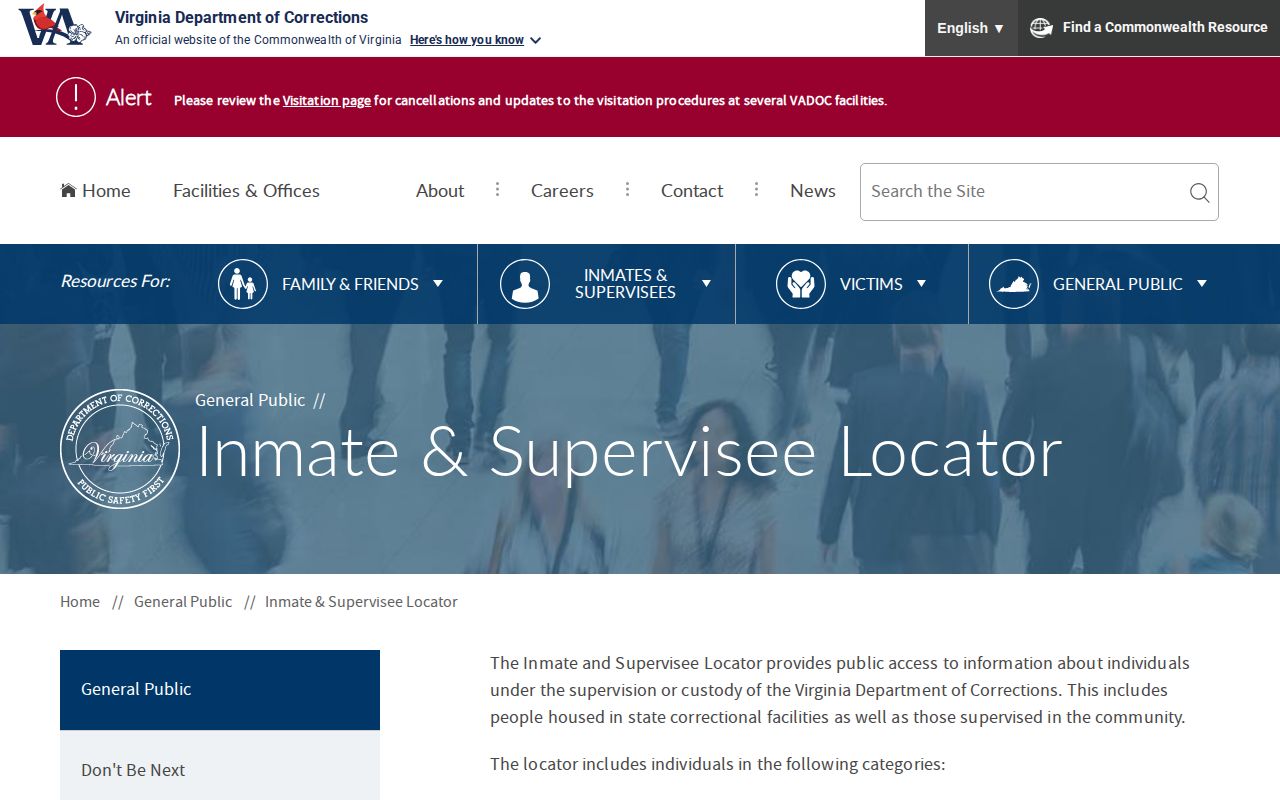
The screenshot supports navigation only. Read the live person's date label as written and never substitute a universal projected-date label.
Note: A new state sentence may not appear at once while the Orange court, CVRJ, and VADOC complete transfer processing.
Virginia Credits Shape Release Dates
Virginia has more than one sentence-credit framework. Good Conduct Allowance generally applies to felony offenses committed before January 1, 1995, and misdemeanors committed before July 1, 2008. For qualifying older parole-eligible terms over twelve months, VADOC may compute discretionary parole eligibility, mandatory parole release, and good-time release dates. The historical class rules can allow from zero through 30 credit days per 30 days served. They require the law that governed the offense period.
Earned Sentence Credits apply to most felony offenses committed on or after January 1, 1995. Virginia Code § 53.1-202.2 defines eligibility and treats one earned credit as one day of incarceration. Under § 53.1-202.3, listed ESC-1 offenses may earn no more than 4.5 days for each 30 days served. Other eligible offenses can fall under levels allowing up to 15, 7.5, 3.5, or zero days for each 30 days served.
The familiar claim that every Virginia prisoner serves 85 percent is too broad. It should never be used to calculate an Orange County release date. The offense, offense date, statutory category, credit level, and conduct all matter. Some offenses are excluded or limited. A classification can also change. Apply the governing rule to the actual sentence instead of subtracting a flat percentage.
- Jail credit
- Qualifying time spent in custody before VADOC receives and computes the state sentence.
- Earned Sentence Credit
- A statutory day of credit earned under the applicable eligibility and rate rules.
- Concurrent sentences
- Terms structured to run at the same time, subject to the court orders and computation rules.
- Consecutive sentences
- Terms structured to follow one another and aggregate differently from concurrent terms.
Note: Modern credit rates should not be applied backward to an older offense governed by Good Conduct Allowance rules.
Why Orange Release Dates Change
A projection changes when the inputs change. VADOC identifies time already spent in jail, sentence type, total active time, the earning-class level, and disciplinary events as computation factors. A corrected court order or newly verified pretrial credit may alter the calculation. Misconduct can reduce future credit earning or change classification. Sentence structure also matters because consecutive terms do not aggregate like concurrent terms.
Custody destination and sentence completion are separate issues. A detainer can alter where someone goes even when the VADOC term ends as computed. A parole decision may open a release route for an eligible sentence, but a board grant is not proof that the physical release has occurred. Virginia abolished discretionary parole for most felonies committed on or after January 1, 1995, under Code § 53.1-40.01, so parole eligibility must be verified from the actual offense and sentence.
| Factor | Possible effect | Best confirming source |
|---|---|---|
| Jail credit | Recognized pre-VADOC time may reduce remaining active time | Sentencing order and VADOC computation |
| Credit class or conduct | Earning rate may rise, fall, or stop | VADOC time computation |
| Corrected court order | Sentence length or structure may change | Orange court clerk and VADOC |
| Concurrent or consecutive terms | Total term aggregates in a different way | Final orders and VADOC computation |
| Detainer or hold | Destination may change after one term ends | Current custodian and receiving authority |
| Parole decision | May authorize a release path for an eligible case | Virginia Parole Board and VADOC |
Orange Jail Versus State Dates
Orange County does not operate a stand-alone adult jail. CVRJ is the regional adult facility. Its record concerns the local commitment, including a release or transfer from that facility. A person may leave CVRJ for the community, another jail, VADOC, or another authority. Ending the Orange commitment does not always end custody. Ask for the release type or destination to keep that distinction clear.
A state projection belongs to VADOC. Its public locator is updated daily and warns that information may be inaccurate or out of date. The live search also requires acceptance of a disclaimer and reCAPTCHA. Because a suitable named record may show different wording based on status, no single field label should be promised for all people. Use the date label actually displayed.
When the label is not exposed or seems unstable, VADOC Operating Procedure 010.3 provides a confirmation route. Staff may confirm a prisoner, probationer, or parolee's projected release date as of the inquiry. Correspondence can be directed to the Correspondence Unit/Court & Legal Section, P.O. Box 26963, Richmond, VA 23261. VADOC's general telephone number is 804-674-3000.
Orange Release and Supervision Dates
Physical release, the start of supervision, and final discharge can occur on different dates. Probation is court-ordered supervision that may follow confinement or be imposed without a prison term. Parole is conditional release for an eligible prisoner before the sentence framework fully ends. Discharge means the custodial or supervision obligation has ended under the responsible authority. None of these terms should be used as a synonym for the others.
Orange County has two supervision layers. VADOC Culpeper Probation and Parole District 26 handles assigned state probation, parole, and community-corrections cases. OAR/Jefferson Area Community Corrections manages documented local pretrial and local-probation programs tied to Orange courts. The order identifies the correct layer. A move from CVRJ to supervised pretrial release is not sentence completion, and a move from state prison to parole is not final discharge.
The VADOC locator can return some people under active supervision, but a fully discharged person may stop appearing. When the question is whether all supervision has ended, obtain the discharge or court record. More detail on this distinction appears in the Orange County Post-Release Supervision resource.
Confirm Orange County Actual Release
A projection becomes history only after release processing occurs. VADOC states that someone whose sentence is satisfied at a state facility is discharged or leaves on parole and receives a notification-of-release letter. The paperwork can include an Order of Release and probation or parole conditions that are read, signed, and witnessed. VADOC also says state-facility release occurs by 11:59 p.m. on the release date, weather permitting. That is a state procedure and should not be attributed to CVRJ.
State release planning can include approved pickup or public transportation, return of property and document envelopes, funds, and certain medication. These steps explain why the actual event is more than a date in a search result. For local custody, CVRJ's own operational record is the source. For either system, compare the final paperwork, current supervision entry, and receiving authority when a detainer or transfer is possible.
A pending-event alert can help with timing, but it is not certified proof. The Orange County VINE Inmate Check explains local-jail notifications and the separate VADOC NAAVI path. Confirm the event with the office that held the person.
Final check: A yesterday projection is weaker than a completed release record, signed order, or current supervision entry from the responsible authority.